REVIEW · TASHKENT
Uzbekistan Tour – 6 Days 5 Nights
Book on Viator →Operated by GOTOUZBEKISTAN · Bookable on Viator
You can see a lot of Uzbekistan without a huge bill. This 6-day, 5-night tour connects Tashkent, Bukhara, and Samarkand with air-conditioned transport, included entry tickets, and high-speed train rides, so your days stay full and your planning stays simple. I also like how the schedule mixes iconic monuments (think Amir Temur and the Registan) with calmer stops like courtyards and memorials, giving you a well-paced taste of the country. One possible drawback: days are packed with multiple sites, so you’ll want decent stamina for steady walking and time in crowds.
The company’s on-the-ground service is a standout value point. In past guest comments, guides named Sunny, Ibrohim, and Ali are credited for friendly, expert help, which matters a lot when you’re trying to make sense of Islamic architecture, Timurid-era sites, and busy bazaars in a short time.
In This Review
- Key highlights at a glance
- Why this Tashkent–Bukhara–Samarkand tour fits a “see it smart” trip
- Day 1 in Tashkent: airport pickup, then breathing room in the city
- Day 2 in Tashkent: Timurid power meets independence-era landmarks
- Day 3 in Bukhara: the fortress start, then the city’s iconic “well” center
- Day 4 in Bukhara: mausoleum, palace residence, and a Sufi-linked stop
- Day 5 in Samarkand: Registan’s dramatic core plus Shah-i-Zinda and a real bazaar
- Day 6 return to Tashkent: a simple exit day
- Price and inclusions: what you’re really paying for
- Getting the timing right: start time, walking pace, and what to bring
- Who should book this tour, and who should skip it
- Should you book GOTOUZBEKISTAN’s 6-day Uzbekistan tour?
- FAQ
- What cities are included in this 6 Days 5 Nights Uzbekistan tour?
- Does the tour include train tickets between cities?
- What meals are included, and are dinners covered?
- What’s included in the price besides hotel and transport?
- Is airport pickup included?
- Is free cancellation available?
Key highlights at a glance
- High-speed train included for the long distance between cities (economy class)
- Most entry tickets included, so you can keep spending predictable
- Small-group feel with a maximum of 28 travelers
- Iconic stops like Registan, Shah-i-Zinda, and Gur Emir
- Real time in marketplaces, including Siyob Bozor in Samarkand
- Airport pickup and mobile ticket for an easier start and finish
Why this Tashkent–Bukhara–Samarkand tour fits a “see it smart” trip
Uzbekistan can feel big when you look at the map, but this route helps you avoid the most stressful part of independent travel: stitching together transport, tickets, and guides across several cities. You get an organized flow through three cities that are central to the country’s history and architecture, plus the practical bonus that high-speed train tickets are built in.
For me, the best value isn’t just the number of landmarks. It’s that the tour includes the stuff that usually burns time and energy when you travel on your own: transfers, entry fees, and the train segments. That leaves you more time to actually look—at tilework, doorways, minarets, domes, and the way each complex sits inside its city.
Price-wise, $1,099 per person is in the “serious but not crazy” band for a cross-city, guided, multi-day program. Where it starts to feel like a good deal is that the package covers five breakfasts, four lunches, 5 nights in a 3-star hotel, and train tickets, plus entrance tickets for most planned sites. You’ll still pay for dinners and personal expenses, but you avoid a long list of surprise add-ons.
A few more Tashkent tours and experiences worth a look
Day 1 in Tashkent: airport pickup, then breathing room in the city
The first day starts with a straightforward move: pickup from the International Airport in Tashkent and transfer to your hotel. After that, you get a free day segment, which is rare in rushed tours and very welcome when you’re landing after a flight.
Here’s how I’d use that open time: get your bearings fast. Tashkent has public transport nearby (the tour notes that), so you can plan a short self-guided wander without feeling locked into the group schedule. If you prefer comfort, you can also rest up and then choose a low-effort walk around the hotel area to shake off jet lag.
Possible consideration: because the next days include several timed monuments, you’ll want to avoid using all your energy on Day 1. Think of it as a buffer so Day 2 doesn’t feel like a nonstop sprint.
Day 2 in Tashkent: Timurid power meets independence-era landmarks
Day 2 leans heavily into Tashkent’s identity through major squares and Islamic landmarks, with each stop giving you a different angle on what the city wants you to notice.
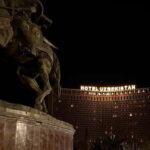
You start at Amir Temur Square, centered on an equestrian statue of Timur (the 1300s ruler). It’s a strong “wake-up” point because it sets the theme for the day: Timurid legacy is not just history here—it’s a visible civic symbol.
Next comes the Amir Timur Museum, a modern domed museum with portraits and artifacts related to the 14th-century ruler. If museums aren’t always your thing, I still think this one is worth it for context; it helps you connect what you see later in Bukhara and Samarkand, where Timurid-era influence is everywhere.
Then you move into civic memory at Independence Square (Mustakillik Square), followed by Memorial Square for soldiers who died during World War II. A separate stop—Monument of Courage Earthquake Memorial—adds another layer by tying local history to resilience. These memorial stops can feel heavy, but they do what good travel should do: they explain a place beyond architecture.
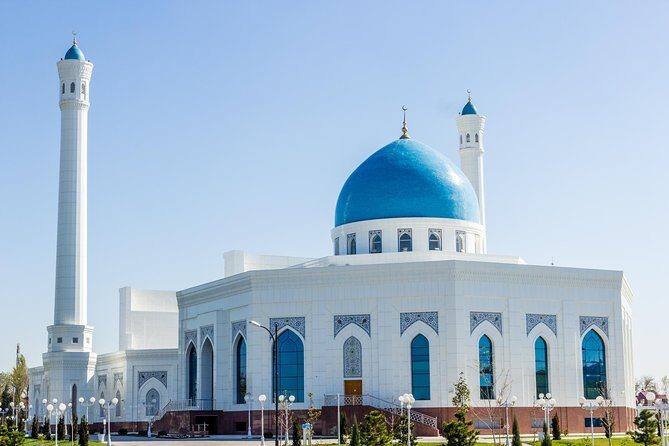
After that, the mood shifts into worship spaces. You visit the Minor Mosque, described as a white mosque with impressive Islamic architecture, and then the Ensemble Hazrati Imam, a centuries-old mosque complex and one of the earliest copies of the Quran. Even if you only spend the planned time at each stop, the contrast between the civic squares and these religious landmarks makes the day feel like a real city tour rather than a checklist.
Day 3 in Bukhara: the fortress start, then the city’s iconic “well” center
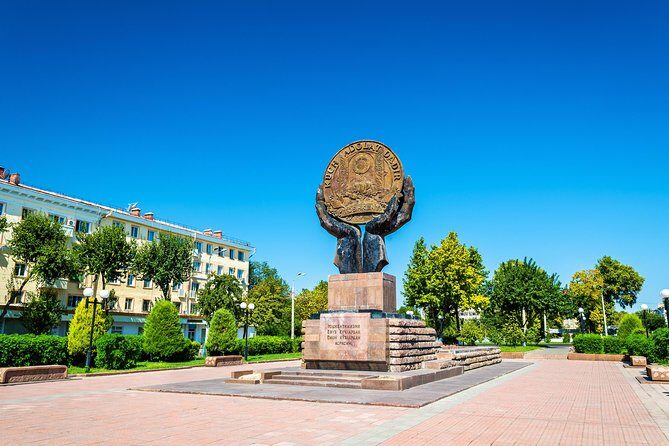
Bukhara’s feel is classic Central Asia: compact, historical, and full of architecture that repeats certain themes—minarets, courtyards, madrassas—so your eye starts to learn the visual language fast.
The day opens with the Ark of Bukhara, a massive fortress originally built and occupied around the 5th century AD. A fortress is an important first stop because it gives you scale. You’re not just looking at pretty buildings; you’re seeing how power was organized.
Next is Lyab-i-Hauz, an architectural ensemble built around a large central water basin. It’s framed by major buildings: Kukeldash Madrasah to the north, the khanaka and Nodir Divan-begi to the west, all tied together around that focal space. This is a good kind of stop for your brain. You can pause, look around, and let the city’s layout sink in.
Then the tour centers back on madrassa architecture with Nodir Devon Begi Madrasasi near the Lyab-i-Hauz well area. From the tour description, it’s tied to vizier Nadir, which helps you remember that these were political and cultural machines, not just schools.
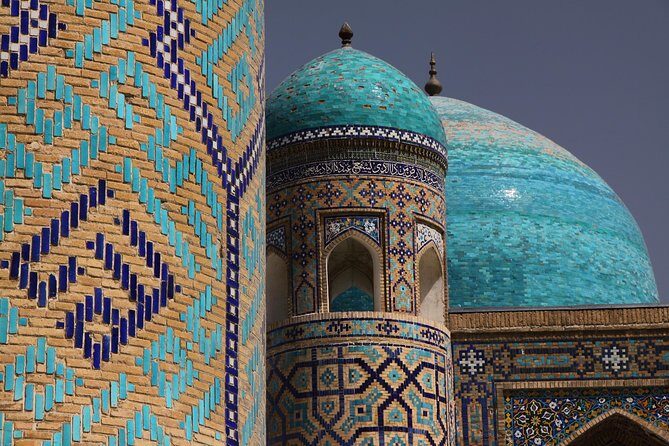
From there, you climb into one of Bukhara’s most recognizable landmark areas: the Great Minaret of the Kalon and the Poi Kalyan Mosque. The Great Minaret is described as one of the most prominent landmarks of the cit, and the mosque is dated to the fifteenth century. I like pairing these two because minarets are both spiritual symbols and wayfinding tools, and it’s easier to see why they were built so tall.
The day closes with Ulugbek Madrasah (founded in 1417) and Mir-i-Arab Madrasa, described as one of Bukhara’s most interesting monuments. Here’s the practical angle: madrassas can start to blur if you visit too many in one day, so I’d focus on noticing what changes—shape, entrance design, how the buildings relate to the streets around them.
Day 4 in Bukhara: mausoleum, palace residence, and a Sufi-linked stop
Day 4 keeps you in Bukhara but shifts from fortresses and minarets to mausoleums, a palace residence, and a religious-culture stop tied to Sufi tradition.
You begin with Bolo Hauz Mosque, built in 1712. Then you head to the big headline structure: Ismail Samani Mausoleum, described as a world-famous architectural masterpiece. Even without going too deep into details, a mausoleum stop helps you understand why this region became known for building that lasts—these weren’t temporary structures.
After that you visit Chor Minor Madrasah, described as a historic gatehouse for a madrasa that was later destroyed. That’s a reminder worth keeping in mind: a lot of what you see today is the surviving shell, not the full original complex. Still, gatehouses matter. They often show the city’s “face” to visitors.
Then comes the Palace of Moon-like Stars (Sitorai-Mokhi-Khosa), the residence of the Emir of Bukhara. This kind of stop adds variety because it shifts you from religious education spaces to elite residence space. It also gives you a sense of what rulers valued—comfort and display—within the broader historical setting.
The day ends with Bahouddin Naqshbandi Ko’chasi, a stop connected to Baha’ al-Din Naqshband, founder of what became a major Naqshbandi Sufi Sunni order. This is a good placement late in the day. By then, you’ve already built up a mental framework of religious and historical sites, so the Sufi connection lands more clearly.
Possible consideration: this is another long monument day. If you’re sensitive to walking fatigue, pace yourself. Water breaks matter, and it’s smart to keep your photo stops efficient rather than trying to capture everything from every angle.
Day 5 in Samarkand: Registan’s dramatic core plus Shah-i-Zinda and a real bazaar
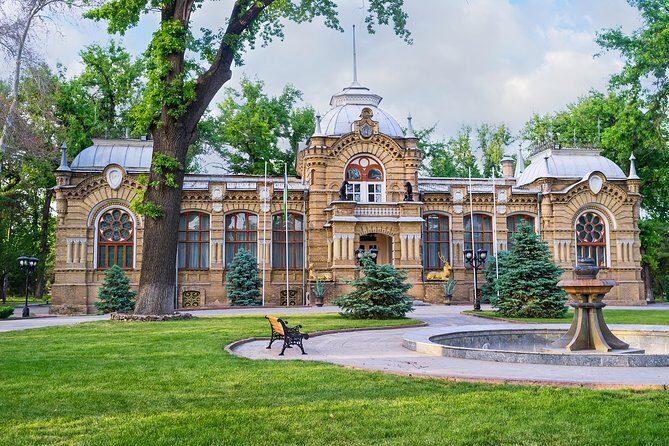
Samarkand is where the tour hits its biggest “wow” area, and it does so in a structured way: first the architecture cluster that defines the city, then the historic religious complex, then the shopping street-energy of a bazaar.
You start with Gur Emir Mausoleum, described as a masterpiece of Islamic architecture of the medieval East. Even though the day quickly becomes a building marathon, the mausoleum works as a foundation—think of it as the emotional center before you step into the public squares.
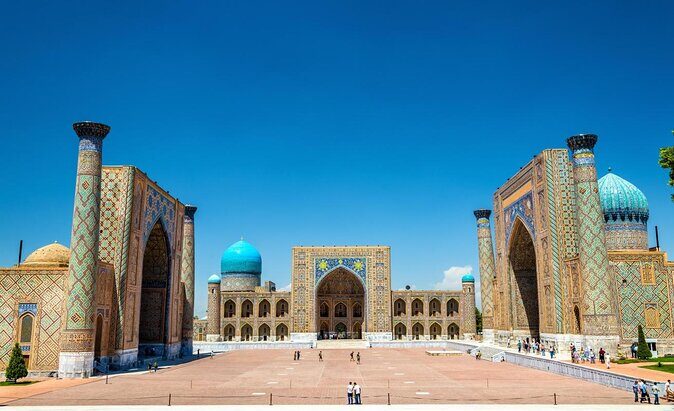
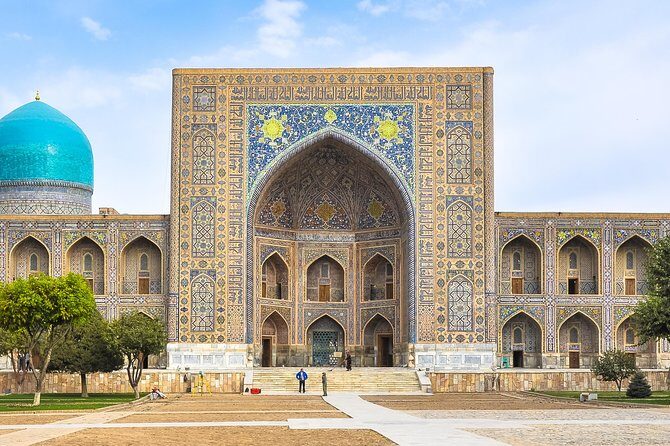
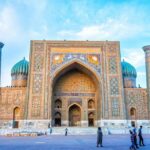
Then you reach Registan, the heart of the ancient Timurid city. The tour doesn’t just point to a square; it follows it with the three major madrassas that form the ensemble:
- Sherdor Madrassah (built 1619–1636)
- Ulugbek Madrasah (1417–1420)
- Tillya Kori Madrasah (built 1660)
Seeing these together is the real trick. Each building is different in date and design details, but your eyes start to read the relationship between them—how the square “frames” the architecture and how the buildings create a stage-like atmosphere.
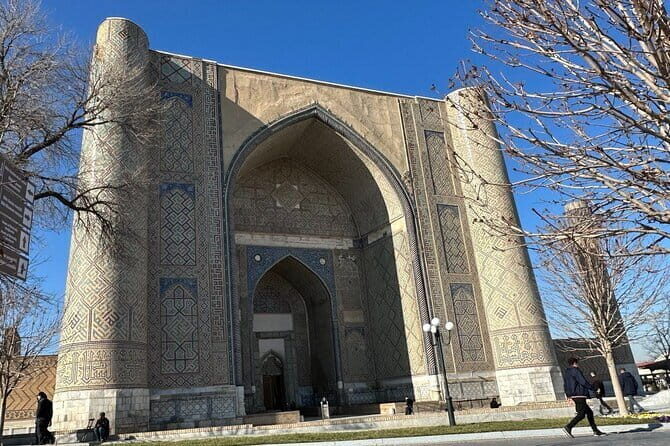
After Registan, you visit Bibi Khanym Mosque, described as one of the largest and most magnificent mosques in the Islamic world in the fifteenth century. This is a major shift from the madrassas of Registan into a big worship space, and it helps balance your mental load.
Then comes Shah-i-Zinda, a complex of 14th–15th century mausoleums. Complexes like this can be photogenic, but what I’d focus on is the pattern: mausoleums, corridors, and how the sequence of spaces shapes your pace.
Finally, you end with Siyob Bozor, described as the largest traditional bazaar in Samarkand. This stop is the tour’s best break from monumental architecture because it puts you into everyday life. Even if you don’t plan to buy much, it’s useful for understanding local rhythm, snack culture, and how busy streets look after big-ticket sightseeing days.
Practical note: bazaars are great for photos, but keep your expectations realistic. You’ll likely see a lot of motion, sound, and negotiations. Keep your phone secured and your schedule flexible.
Day 6 return to Tashkent: a simple exit day
The last day is easy: transfer to the International Airport Tashkent. There’s also a free day segment in the plan, so you aren’t forced to rush straight from the final sights to the airport without a buffer.
How you use that time depends on your flight, of course, but the key is to plan for the end-of-trip logistics. On days like this, I always try to do small “wrap-up” tasks early—water, chargers, a final walk—so you don’t scramble right before leaving.
Price and inclusions: what you’re really paying for
At $1,099 per person, this tour is priced for travelers who want guided structure without luxury-level pricing. What makes it feel reasonable is that several of the biggest costs are already covered.
Included:
- Air-conditioned vehicle
- Entrance tickets
- Train tickets (economy class) for Tashkent–Bukhara–Samarkand–Tashkent using high-speed train
- 5 nights in a 3-star hotel
- Breakfast (5) and lunch (4)
Not included:
- Travel insurance
- Dinners
- Personal expenses
- Any extra fees for trying on traditional clothes for photos (if you want that)
The practical reality: you’ll still need money for dinner most nights and for personal souvenirs. But because entry fees and the train are included, your budget usually stays cleaner than with a “book your own tickets” style plan.
Also consider the group size. With a maximum of 28 travelers, you’re not in an enormous crowd, and that tends to make city navigation smoother during monument visits.
Getting the timing right: start time, walking pace, and what to bring
The tour start time is 7:00 am, so you should plan on early mornings. That’s not a problem for most people, but it’s the kind of detail that changes how you pack and how you sleep the night before.
The tour notes a moderate physical fitness level. That doesn’t mean “athlete.” It does mean you should be comfortable with steady walking across multiple stops in a day and spending time outdoors, especially around squares and complexes.
What I recommend bringing:
- Comfortable walking shoes (you’ll stand and walk a lot)
- A light layer (mosques and outdoor stops can vary)
- A reusable water bottle
- Modest attire items if you want to feel comfortable inside religious spaces
- Phone storage for lots of monument photos
If you like history-meets-people moments: this tour has a human factor. In guest feedback, the guides—Sunny, Ibrohim, and Ali—are praised for customer service and friendliness, which can make the difference between just seeing buildings and actually understanding what you’re looking at.
Who should book this tour, and who should skip it
This is a strong match if you:
- Want the core Uzbekistan hits in a short 6-day loop
- Prefer included tickets and transport over coordinating everything yourself
- Like guided context, especially around Islamic architecture and Timurid-era landmarks
- Appreciate a schedule that includes both major monuments and a bazaar stop
You might skip it if you:
- Want lots of free time each day to wander without a set flow
- Have very limited mobility and need minimal walking between stops
- Expect luxury hotel comfort (this is 3-star lodging)
The early start and packed monument schedule can be great if you enjoy momentum. If you don’t, you might feel rushed.
Should you book GOTOUZBEKISTAN’s 6-day Uzbekistan tour?
I’d book this if you want a guided, budget-conscious way to see Tashkent, Bukhara, and Samarkand with train rides, entrance tickets, and meals handled. It’s especially good for first-timers because the route hits major cultural anchors: Amir Temur’s sphere in Tashkent, Bukhara’s minarets and courtyards, and Samarkand’s Registan and Shah-i-Zinda.
If your style is slower travel and you hate structured days, then treat this as a “planned sightseeing sprint.” But if you want the practical benefits—airport pickup, air-conditioned transport, included tickets, high-speed train segments, and friendly guides—this one is built for you.
FAQ
What cities are included in this 6 Days 5 Nights Uzbekistan tour?
The tour is based in Tashkent, Uzbekistan, and it includes visits to Tashkent, Bukhara, and Samarkand during the 6 days.
Does the tour include train tickets between cities?
Yes. Train tickets for the high-speed train are included in economy class for the route Tashkent–Bukhara–Samarkand–Tashkent.
What meals are included, and are dinners covered?
Breakfast is included for 5 days and lunch is included for 4 days. Dinners are not included.
What’s included in the price besides hotel and transport?
Entrance tickets and accommodation for 5 nights in a 3-star hotel are included. Air-conditioned vehicle transport is also included.
Is airport pickup included?
Yes. The tour includes pickup from the International Airport in Tashkent and transfer to the hotel, and it also includes transfer back to the airport on the final day.
Is free cancellation available?
Yes. You can cancel for a full refund up to 24 hours before the experience start time. If cancelled less than 24 hours before, the amount paid is not refunded. The policy also notes the experience may be rescheduled or refunded due to poor weather or if a minimum traveler number isn’t met.