REVIEW · TASHKENT
Bukhara One Day Tour – Departure From Tashkent
Book on Viator →Operated by GOTOUZBEKISTAN · Bookable on Viator
Bukhara in one day sounds unreal. This private day trip uses the Afrosiyob fast train plus guided walking through the city’s top mosques, madrassas, mausoleums, and Ark. I like that it’s built for maximum sightseeing time without you having to plan every hop. I also like the balance of major monuments with smaller stops like the Magoki-Attori area and the Trading Domes, so the city feels lived-in, not just staged.
You’ll want to consider the schedule. It’s a long day (about 12 to 16 hours), with a very early start and fixed time windows at each stop. If you slow down easily, or you like museums and crafts shops to take over your pace, you may feel the time pressure.
In This Review
- Key things to know before you go
- A one-day Bukhara plan that moves like a time machine
- Getting from Tashkent to Bukhara on the Afrosiyob
- Guided old-city loop: Lyabi Khause and the “square-heart” of Bukhara
- Magoki Attori and Chor Minor: smaller stops with big character
- Trading Domes: where the old city still shops
- Po-i-Kalyan complex: Kalyan Minaret, Kalyan Mosque, and Mir-i-Arab
- Ulugbek Madrasah and Abdulaziz-Khan Madrasah: learning architecture in two styles
- Ark of Bukhara and Bolo Hauz: power, fort walls, and a UNESCO setting
- Samanid Mausoleum and Chasma Ayub: early architecture and water meaning
- Lunch, pacing, and how not to run out of energy
- Price and value: what you’re really paying for
- Who this Bukhara one-day tour suits best
- Should you book GOTOUZBEKISTAN’s one-day Bukhara tour?
- FAQ
- What time does the tour start?
- How long is the whole trip from Tashkent to Bukhara and back?
- Is round-trip transport included?
- Are entrance fees and lunch included?
- Is this a private tour?
- What should I do if the high-speed train isn’t available?
- What happens if the weather is poor or too few travelers sign up?
Key things to know before you go
- Afrosiyob morning timing: Tashkent departure at 07:30 and arrival in Bukhara at 11:17. You can nap on the ride.
- Private group experience: you and your group only, with a guide and a driver handling the moves.
- Lunch included: you won’t have to guess where to eat between monuments.
- Every major “must-see” is in one loop: from Lyabi Khause to Po-i-Kalyan, then Ark, Bolo Hauz, Samanid, and Chasma Ayub.
- Time is boxed per stop: many stops are around 30 minutes, so you’ll skim and appreciate rather than linger all day.
- Meeting matters: the plan includes meeting your guide/driver at the Bukhara station, so confirm details to avoid early-station hassle.
A one-day Bukhara plan that moves like a time machine
Bukhara has a way of making centuries feel close. You’ll see sites that date back to the early Islamic era and still function today as schools, places of worship, and community spaces. It can feel a bit like stepping into a film set—except the details are real, carved in stone, and still standing.
The biggest reason this tour works is how efficiently it layers Bukhara’s themes. You start with the old city social core around Lyabi Khause, then you shift toward religious education at the madrassas, and finish with authority and spirituality at the Ark and the mausoleums. That flow helps your brain “connect the dots” instead of collecting photos.
And yes, it’s intense. But the payoff is that you’ll cover what most people need 2 to 3 days to do, and you’ll do it with transport, entrances, and lunch handled.
A few more Tashkent tours and experiences worth a look
Getting from Tashkent to Bukhara on the Afrosiyob
Your day starts early, but the rhythm is smart. You get transferred to the Tashkent Railway Station at 06:30, and the high-speed Afrosiyob train departs at 07:30. Arrival in Bukhara is at 11:17, which gives you a real half-day in the city rather than a token evening loop.
If you like to use transit time for rest, this is one of the best parts of the plan. The ride is about 4 hours, and you can use it to reset before the walking begins. There’s also a fallback if the high-speed train isn’t available: the operator replaces it with the most comfortable regular train option.
One practical point: because this day is built around fixed departures, you’ll feel best if you keep your morning routine simple. If you’re the type who needs extra time at check-in spots, plan to leave earlier than you think you’ll need.
Guided old-city loop: Lyabi Khause and the “square-heart” of Bukhara
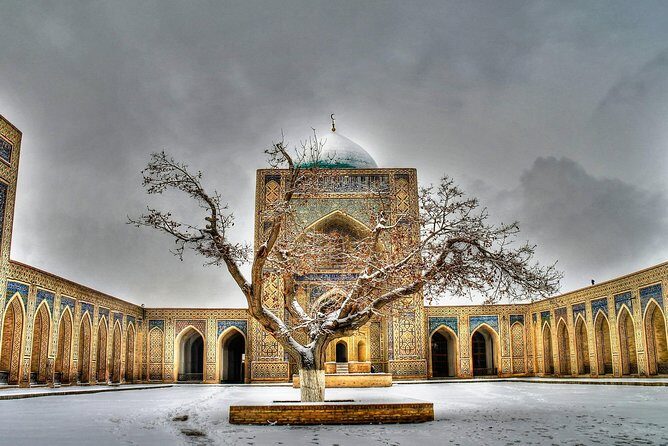
Once in Bukhara, you move into the historical center with your guide. The tour starts at the Lyabi Khause ensemble, a monumental architectural cluster around a central square that historically connects to a reservoir.
Here’s what makes this stop worth your attention. You’ll stand in a place where multiple big buildings form a single visual story: Kukeldash Madrasah to the north, plus the Khanaka and Nodir Divan-begi on the other sides. The square’s design and the way it frames movement tell you how public space used to function—part gathering area, part civic stage, part life-support for the neighborhood.
A nice bonus is that you’re not only seeing one building. You’re learning how Bukhara’s architecture “thinks” in ensembles, where the space between structures is part of the design.
Magoki Attori and Chor Minor: smaller stops with big character
Next you’ll visit the Magoki Attori Mosque and a carpet museum. The mosque itself is an example of an urban mosque set into the residential-quarter feel of the city center. Even with limited time, you’ll get the sense of how worship space sat close to daily life.
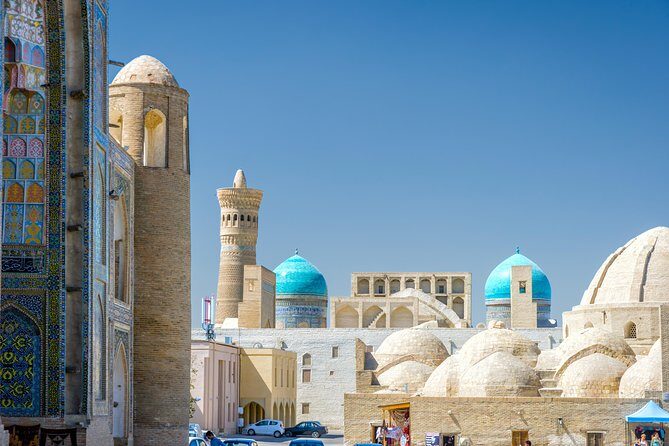
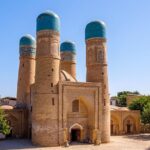
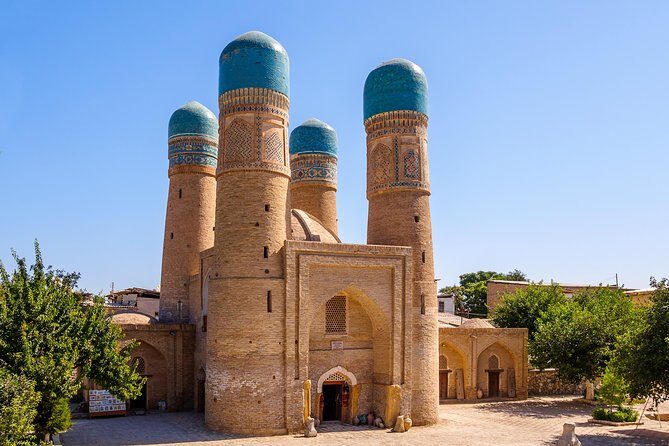
Right behind Lyabi Khause is Chor Minor Madrasah, known as the “four minarets.” The name is literal: the corners of the madrasah building are decorated with four small minarets topped with blue domes. The best part is that the decorations are different across the four minarets, which is exactly the kind of detail you miss when you rush.
Drawback to keep in mind: these stops are short. If you want to read every inscription line-by-line, you’ll need to move a little faster than your curiosity. The tour is set up for appreciation, not deep study.
Trading Domes: where the old city still shops
Then you’ll head to the Trading Domes, a large complex with a hexagonal orientation under one massive spherical dome. This is a very different feeling from the mosques and madrassas. You’re in a covered commercial space where crafts and souvenirs are part of the scene.
The shops are geared toward practical Central Asian wares: knives, jewelry, music instruments, and remembrances. It’s a good moment to slow down for a few minutes, even if the tour window is tight. If you like to pick up small gifts, this is a place to do it while you’re already in the right zone.
A word of caution: market-time can expand quickly if you wander. If you’re the type who can disappear into shop browsing, use your guide as a timer and keep moving so you don’t lose your spot in the monument sequence.
Po-i-Kalyan complex: Kalyan Minaret, Kalyan Mosque, and Mir-i-Arab
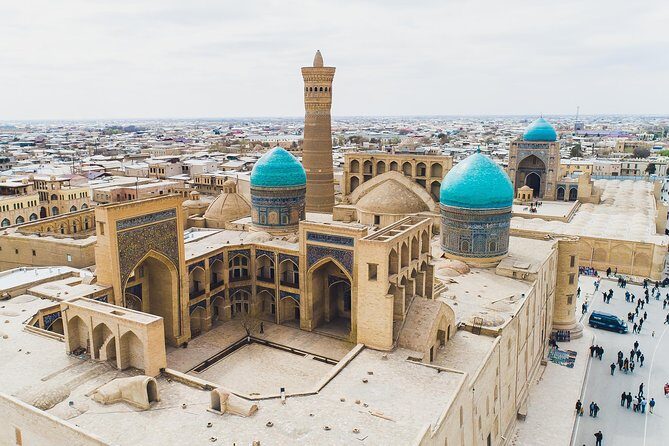
After the trading domes, you’ll reach the Po-i-Kalyan area, one of Bukhara’s most iconic religious landmarks. You start with the Kalyan Minaret, one of the city’s most prominent markers. It’s the kind of structure that gives your bearings—once you see it, the rest of the complex feels easier to place.
From there, you visit the Kalyan Mosque, dating back to the 15th century. Even in short time windows, the scale and layout help you understand why this is a centerpiece rather than a side attraction.
Then comes Mir-i-Arab Madrasa. This is a key “living” stop because it’s still active as an institution where future imams and religious mentors receive education. That detail matters. It turns the building from a photo subject into a functioning part of the city’s religious life.
Ulugbek Madrasah and Abdulaziz-Khan Madrasah: learning architecture in two styles
You’ll continue with Ulugbek Madrasah, built in 1417 by Ismail Isfagani and Najmeddin Bukhari. What I like about seeing Ulugbek here is the contrast in character: the structure has relatively little decoration, yet it looks impressive and even majestic. That’s a good reminder that Islamic architecture isn’t only about color and ornament—it’s also about proportion.
Next is Abdulaziz-Khan Madrasah, built in 1651 to 1652 and described as the last large madrasah in Bukhara. The composition is typical in the sense that it uses a four-iwan yard, but the interior details feel more unusual. The design includes divergent fan of hudj groups after the side ayvans, plus cupola buildings along the central axis.
Time-wise, you’ll probably feel the difference in how you experience these buildings. Ulugbek can feel calm and architectural, while Abdulaziz-Khan can feel more structured and visually “busy” if you pause to notice the plan.
Ark of Bukhara and Bolo Hauz: power, fort walls, and a UNESCO setting
Now you shift from education and worship to authority. The Ark, also called Ark Fortress or Ark-Citadel, is the residence of Bukhara khans. Excavations suggest the citadel site dates back to the 4th century BC, which is a wild detail when you stand in a modern city and realize the ground under you has held layers for millennia.
The Ark’s scale is partly explained by the setting: a 20-meter-high artificial hill formed from repeated building and destruction. That’s why it feels like it rises above the city rather than sitting among it.
Then you’ll visit Bolo Hauz Mosque, built in 1712 across from the Ark in the Registan district. This mosque is part of the UNESCO World Heritage Site listing that covers key parts of the historic city. Even if you don’t spend ages reading everything inside, the placement—facing the Ark—helps you see the historical balance between rulers and religion in one compact area.
Samanid Mausoleum and Chasma Ayub: early architecture and water meaning
You’ll finish with two mausoleum experiences that add emotional texture after the forts and schools.
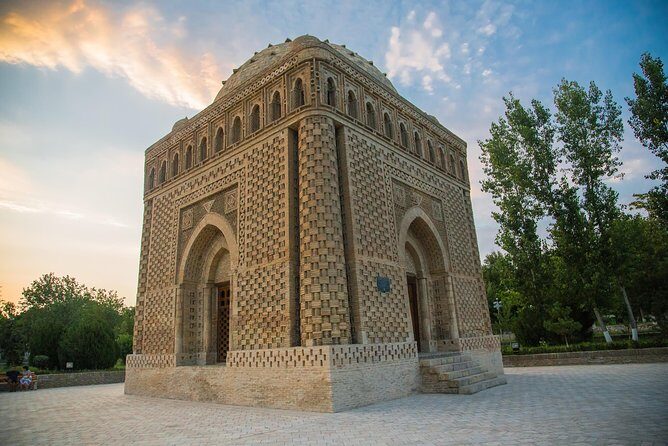
First is the Ismail Samani Mausoleum, a Samanid structure from the 10th century C.E. It’s known as an iconic example of early Islamic architecture and also as the oldest funerary building of Central Asian architecture. This is the kind of stop where even a short visit can feel like a reset, because mausoleums pull your attention to form, symmetry, and quiet details.
Finally, you’ll visit Chasma Ayub Mausoleum. This site includes a mausoleum and a holy spring, and there’s also a Museum of Water associated with it. The building was ordered by Karakhanid rulers in the 12th century, rebuilt over the 14th to 19th centuries, and completed during Tamerlane’s reign. That long timeline makes the spring feel more than scenic—it’s a reason people gathered, prayed, and remembered.
If you like cultural meaning beyond monuments, this is where you’ll likely feel the most connection. A holy spring tied to a museum gives you a “why” alongside a “what.”
Lunch, pacing, and how not to run out of energy
Lunch is included, which is genuinely helpful on a day like this. You don’t want to spend your limited time in between sites hunting for food or translating menus while everyone else is waiting.
Pacing is the real variable. The tour uses structured time blocks—many stops are around 30 minutes, and the Lyabi Khause ensemble gets about an hour. That means you’ll see the highlights, but you’ll also need to choose how you spend your minutes inside each site.
Here’s what works best in this kind of day trip:
- Take quick photos early at each stop, then focus on one or two details later.
- Keep water handy so you don’t slow down from thirst rather than fatigue.
- If you get tempted by shops, set a personal limit so the market doesn’t steal your monument time.
By the end, you’ll likely feel travel tired. Still, the schedule is built so you get taken back to the airport for your Bukhara-to-Tashkent flight in the evening, arriving back in Tashkent around midnight.
Price and value: what you’re really paying for
At $249 per person, you’re paying for a tight package: train tickets Tashkent to Bukhara (economy), flight back from Bukhara to Tashkent (economy), entrance fees for all sightseeing stops, transportation throughout, and lunch.
The value comes from the fact that you’re buying time and certainty. In one long day, you don’t just go to Bukhara—you also get the logistics that can be the hardest part of Central Asia travel: lining up intercity transport and making sure you’re at each site at the right time.
It’s also a good deal if you’re not excited about doing all planning yourself. With a guide shaping the flow and handling entries, you get a coherent route rather than a pile of places.
Main consideration on value: if you’d rather linger at each stop and you don’t like being on a schedule, you may feel the day is “too efficient.” Efficiency is the product here.
Who this Bukhara one-day tour suits best
This works especially well if:
- You have limited time in Tashkent and want a real taste of Bukhara.
- You want guided context for mosques, madrassas, mausoleums, and the Ark, without renting cars or figuring out routes.
- You enjoy seeing religious and civic architecture as part of one storyline.
It might not be ideal if:
- You hate early starts or long travel days.
- You plan to spend serious time inside museums or on shopping detours.
- You want a slow, flexible pace rather than fixed windows.
Should you book GOTOUZBEKISTAN’s one-day Bukhara tour?
I’d book it if you want a high-impact day with transport and entrances taken care of, and if you’re okay with a schedule that prioritizes highlights. The route is smart: it covers the classic Bukhara ensemble sites, the Po-i-Kalyan landmark area, the Ark, UNESCO-listed Bolo Hauz, and ends with Samanid and Chasma Ayub so the day feels complete.
I’d think twice if you’re the type who needs lots of cushion time, because the structure means you’ll move briskly. Also, since the plan includes meeting your guide/driver at the Bukhara station, you’ll feel calmer if you confirm exact meeting details before you leave Tashkent.
If you do your part—show up on time, keep your energy up, and treat market stops as optional flavor—you’ll come away with the kind of Bukhara day that sticks.
FAQ
What time does the tour start?
The start time is 7:00 am. You’re transferred to the Tashkent Railway Station at 06:30 am, and the Afrosiyob train leaves at 07:30 am.
How long is the whole trip from Tashkent to Bukhara and back?
The duration is listed as 12 to 16 hours. You return to Tashkent in the evening, around midnight.
Is round-trip transport included?
Yes. The tour includes train tickets from Tashkent to Bukhara (economy) and a flight from Bukhara back to Tashkent (economy), plus all transportation during the day in Bukhara.
Are entrance fees and lunch included?
Yes. Entrance fees for all sightseeing places and lunch are included.
Is this a private tour?
It’s described as a private tour/activity, meaning only your group participates.
What should I do if the high-speed train isn’t available?
The information says that on rare occasions when the high-speed train is unavailable, the operator will replace it with the most-comfortable class of regular train.
What happens if the weather is poor or too few travelers sign up?
The experience requires good weather. If it’s canceled due to poor weather, you’ll be offered a different date or a full refund. The same applies if a minimum number of travelers isn’t met: you’ll choose another option or get a refund.