REVIEW · SAMARKAND
The Golden City of Samarkand: A Self-Guided Audio Tour
Book on Viator →Bookable on Viator
Samarkand’s monuments have a way of doing too much. This self-guided Golden City audio tour turns the volume down and gives you a clean route through the big hits and quieter corners. It’s timed to GPS locations, so you can slow down when a detail grabs you.
I particularly love the offline setup: audio, maps, and geo-data work without cellular service. I also like that the tour mixes the postcard sights—like the Registan—with street-level stops such as Siab Bazaar and local chaikhanas for tea breaks.
One real drawback to plan for: the system relies on GPS pins, so the first few minutes can feel a bit fiddly. Once you’re standing at the right spot and start the next segment, it gets much easier.
In This Review
- Key things I’d focus on before you start
- Why Samarkand works so well for GPS audio
- Price and what you truly get for $6.99
- Getting rolling at Shah-i-Zinda Street (and avoiding the GPS stumble)
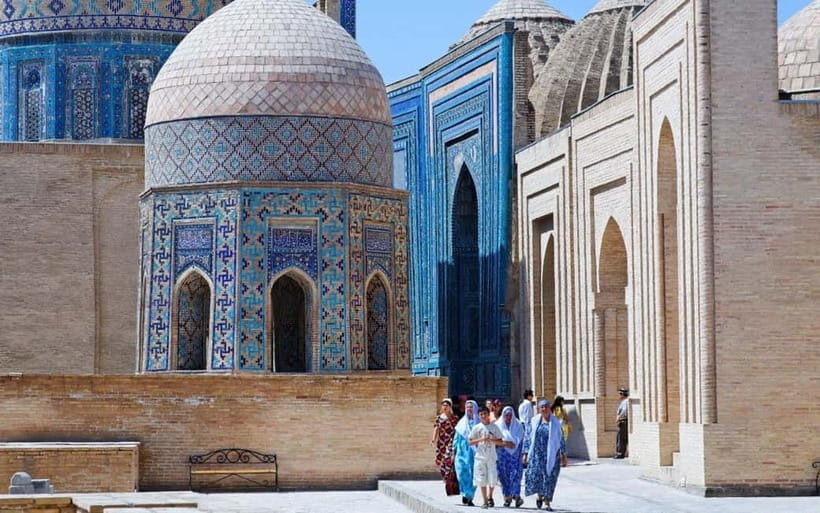
- Stop by stop: Shah-I-Zinda’s mausoleums and the bowing doorway idea
- Stop by stop: Siab Bazaar’s roof, shade, and what to hunt for
- Stop by stop: Bibi Khanym Mosque and Timur’s showpiece after 1399
- Stop by stop: Registan—how to see it without rushing
- Stop by stop: Sher Dor’s photographer-friendly quirk (and who finished it)
- Timing, pacing, and how long the loop really takes
- VoiceMap offline mode: your best prep before you leave your hotel
- Where this tour shines (and who should skip it)
- Should you book the Golden City of Samarkand?
- FAQ
- How much does the Golden City of Samarkand audio tour cost?
- How long is the tour?
- Do I need an internet connection during the tour?
- What app do I use to play the tour?
- Where does the tour start and end?
- Are tickets or entrance fees included?
- Is the tour private?
- Can I cancel and get a refund?
- Is it available year-round?
Key things I’d focus on before you start
- GPS-timed audio means you don’t need to rush from one stop to the next
- No connectivity needed: download once, then wander offline with maps and geo-data
- Icon + local mix: Registan alongside markets and tea-house culture
- Historic details you can actually use: why certain buildings are shaped the way they are
- Lifetime access so you can repeat the route later as your knowledge grows
- Budget-friendly price for a curated walking circuit you control end-to-end
Why Samarkand works so well for GPS audio
Samarkand is famous for landmarks that feel close together, but they’re spread by walls, lanes, and sudden changes in street life. A GPS audio tour helps you connect the dots without needing to constantly check your map or guess which gate you’re approaching.
I like tours like this because they respect your pace. If you want a photo, you can take it. If you want to sit for tea, you can do that too, then move on when you’re ready.
The tour also leans into both the public face and the everyday rhythm. You’ll hit major monuments, but you’re also guided toward real street scenes—where the city feels lived-in.
You can also read our reviews of more guided tours in Samarkand
Price and what you truly get for $6.99
At $6.99, this is one of those rare deals where the cost is mostly a rounding error compared to the time you save figuring things out. You’re paying for audio guidance, offline navigation support, and a structured route through Samarkand’s highlights.
What you should expect: it’s not a guided talk with a person. You’re doing it yourself, using the VoiceMap app, at your pace. That can be a great fit—especially if you enjoy learning from your headphones and moving when it’s comfortable.
What you should watch for: there’s no mention of included museum tickets or entrance fees. If any stop requires payment for specific areas, you’ll handle that separately.
Getting rolling at Shah-i-Zinda Street (and avoiding the GPS stumble)
Your start point is Shah-i-Zinda Street (Shоhi Zindа ko’chasi). Because the tour is pegged to GPS locations, you’ll want to stand near the pin before you begin each segment. This is where the main “machinoso” feeling shows up for many people: the early minutes can be a little awkward.
A practical trick: before you fully commit to walking, spend a minute confirming you’re at the right start spot. Then start the first audio track and let it guide your steps.
Once you find the rhythm—park yourself near the location, listen, then walk to the next—the tour becomes much smoother. The appeal is the freedom: no waiting for someone else, no rigid group pacing.
Stop by stop: Shah-I-Zinda’s mausoleums and the bowing doorway idea
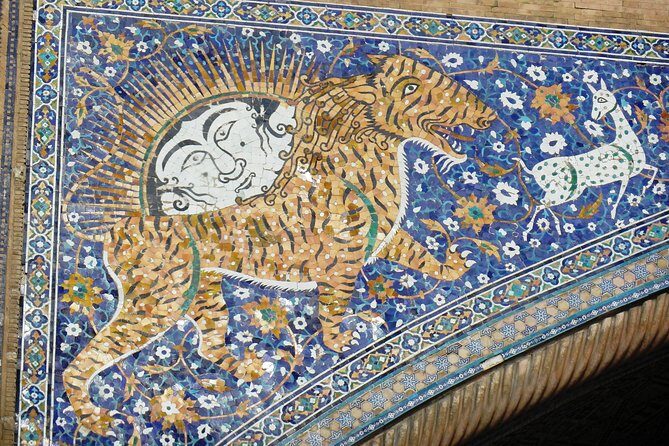
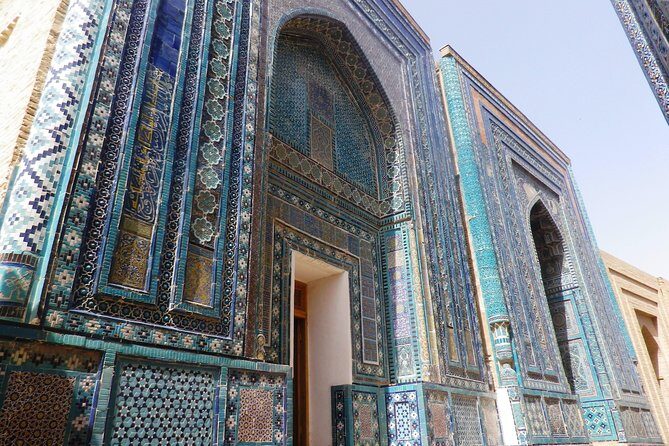
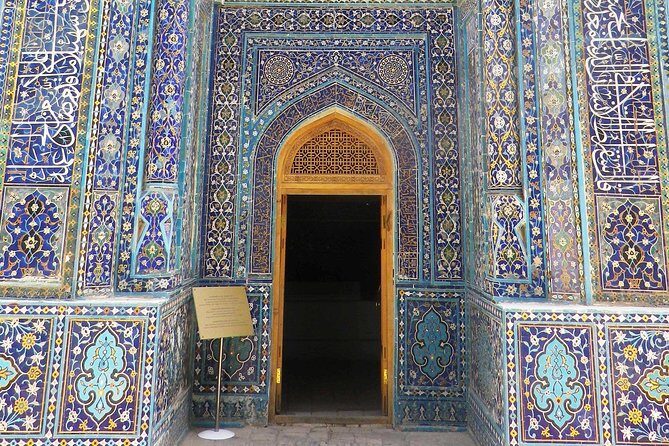
The first major stop is Shah-I-Zinda, a complex that originally dates to the 9th century. The audio focuses on how the architecture makes devotion unavoidable, including the idea that the tiny doorways practically force you to bow as you move through.
This is the kind of place where details matter more than distance. Instead of just admiring the scale, the tour nudges you to notice the human experience: the narrow passages, the way movement slows you down, and how pilgrims have left gifts tied to the graves.
A nice part here is that the tour doesn’t treat it like a museum display. You get prompted to read the space like a living devotional route—something you can still feel even as a visitor.
Stop by stop: Siab Bazaar’s roof, shade, and what to hunt for
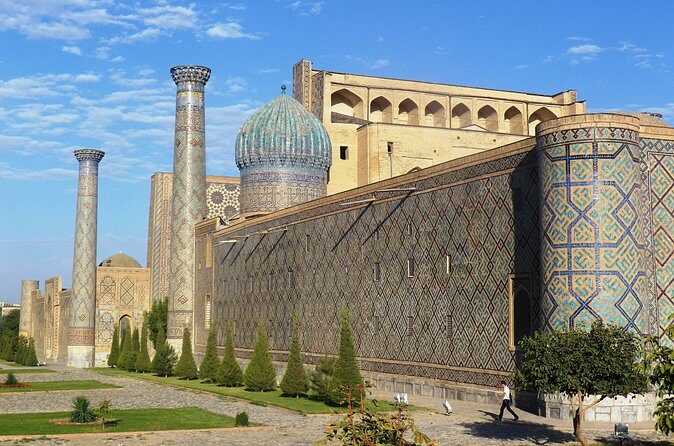
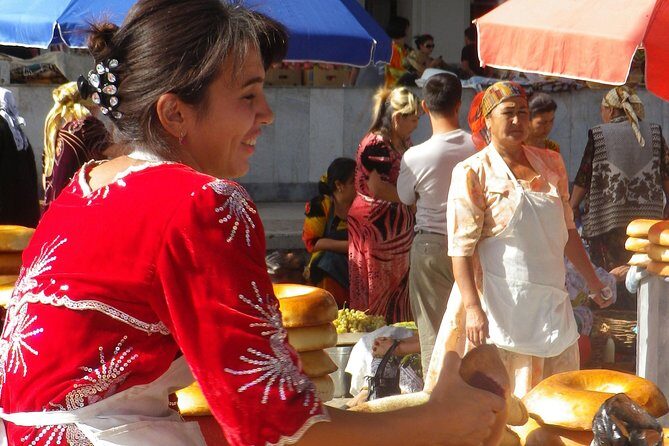
Next comes Siab Bazaar, where the atmosphere is half market, half shelter. The description paints a vivid picture: girders holding up a two-tier, corrugated roof that’s basically an industrial umbrella, with traders tucked under faded gazebos and parasols.
What you should do at this stop is simple: look at variety. The tour language emphasizes that you can find a wide range of goods here, which is exactly how a market should be experienced—less like a checklist, more like a wandering scan of textures and colors.
Also, markets are perfect for taking your time because they naturally slow your pace. If you want to snack or buy something small, this is the moment. The tour is designed to help you notice local life, not just the monuments.
You can also read our reviews of more city tours in Samarkand

Stop by stop: Bibi Khanym Mosque and Timur’s showpiece after 1399

Then you move to Bibi Khanym Mosque, commissioned by Timur after his campaign in India in 1399. The tour’s angle is about scale and power—specifically the claim that treasures plundered from the subcontinent were used in construction.
This stop is a good reminder that Samarkand’s monuments were built through big political decisions, not only architectural taste. The audio also points out that Timur ignored his architect’s advice and pushed ahead with a very specific direction.
The practical value for you: when you look at Bibi Khanym, you’ll understand why it has that “statement” feeling. It’s meant to command attention, and now you know the backstory for what that command cost and required.
Stop by stop: Registan—how to see it without rushing
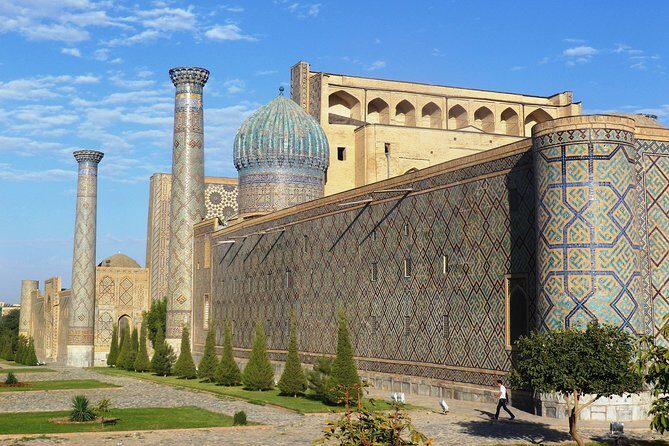
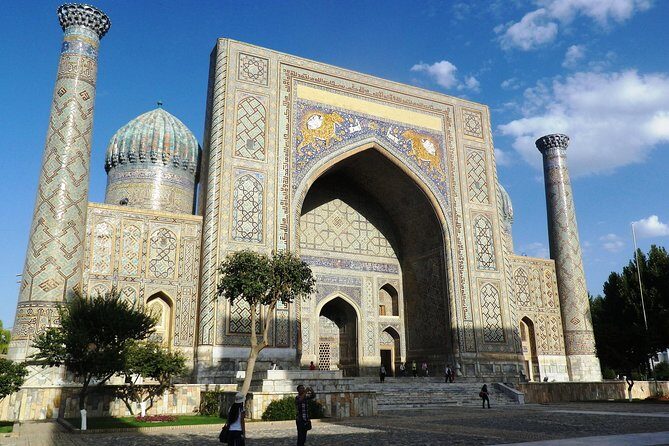
Registan is the holy grail for many visitors. The tour treats it like a centerpiece that’s worth approaching slowly, because this is where you can feel the layering of influences and eras in one wide-open public space.
Instead of generic admiration, the audio connects Registan to the region’s intellectual reputation—mentioning Al-Khorezm. Even if you only catch the highlights, it helps you understand this city wasn’t just about rulers and buildings. Learning, math, and scholarship were part of the same cultural orbit.
My advice here: take a full moment before you start photographing. Stand back, observe how the square frames views, then walk in closer. If you rush straight to the details, you miss the structure of the space.
Stop by stop: Sher Dor’s photographer-friendly quirk (and who finished it)

The tour ends its main arc with the Sher Dor feature, described as an imitation of the original Ulugbek Madrassa—but with a quirk that photographers love. The key idea is that it’s not just a copy. It has a recognizable personality that makes it visually memorable.
The mosque was completed in 1636 under Shaybanid Emir Yalangtu. That date helps you place it chronologically and reinforces how Samarkand kept rebuilding itself across centuries.
If you care about photos, this is the stop where you’ll likely start seeing why the tour calls it out. Look for what makes it different from the expected version—then frame it with the geometry around it.
Timing, pacing, and how long the loop really takes
The tour runs about 1 hour. That doesn’t mean you’ll be sprinting. Because the recordings are timed to GPS locations, the listening pace sets your walking rhythm.
If you like to read and stop for moments—market scanning, doorway details, big-square views—expect it to be closer to the upper end. If you’re more focused and keep moving, you can finish efficiently.
Also, check your day’s context. Samarkand can be hot, and walking between monuments is still walking. The best strategy is to start earlier in the day if the weather is harsh, and save shade breaks for market or chaikhana moments when the tour nudges you there.
VoiceMap offline mode: your best prep before you leave your hotel
The big practical win is that you get offline access to audio, maps, and geo-data through the VoiceMap application. That’s huge in places where cellular service may be spotty or expensive.
Before you head out, do these basics:
- Download the audio before you arrive at the start area
- Bring headphones you trust (quiet earbuds beat loud speaker noise here)
- Keep your phone battery in mind for the full hour plus extra wandering
If your GPS is slow to lock, give it a minute. Don’t panic. Stand still for a bit, then start the next segment.
The whole point is independence, so you’re not hunting for service while standing in front of a monument.
Where this tour shines (and who should skip it)
I’d call this a strong choice if you like structure without a rigid schedule. You’ll appreciate GPS timing if you hate the mental load of constantly re-checking maps.
It also fits travelers who enjoy cultural context. The stop summaries aren’t just architecture. They talk about devotion, power, trade energy, and the people behind the buildings.
Skip this (or pair it) if you want a live guide answering questions in real time. Also, if you absolutely hate tech setup and GPS pins, the first few minutes might frustrate you even with offline support.
Should you book the Golden City of Samarkand?
Yes—if you want an affordable way to learn what you’re seeing and you’re comfortable walking on your own. For $6.99, the mix of Registan, Shah-I-Zinda, and Siab Bazaar plus offline navigation is strong value.
Book it especially if you plan to arrive with limited context. The audio cues help you see the city with less guessing and fewer dead ends.
I’d decide no if you already have a detailed itinerary and don’t care about audio storytelling. But if you like “point, listen, walk,” and you want your time to feel purposeful, this is an easy yes.
FAQ
How much does the Golden City of Samarkand audio tour cost?
It costs $6.99 per person.
How long is the tour?
The tour is listed as about 1 hour (approximately).
Do I need an internet connection during the tour?
No. You get offline access to audio, maps, and geo-data, so connectivity isn’t required.
What app do I use to play the tour?
You use the VoiceMap application.
Where does the tour start and end?
It starts on Shah-i-Zinda Street (Shоhi Zindа ko’chasi) and ends on Tashkent Road (Toshkent yo’li).
Are tickets or entrance fees included?
No. The tour does not include tickets or entrance fees for museums or other attractions en route.
Is the tour private?
Yes. It’s listed as a private tour/activity, meaning only your group will participate.
Can I cancel and get a refund?
No. This experience is non-refundable and cannot be changed for any reason.
Is it available year-round?
The listed opening hours show Monday to Sunday, 12:00 AM to 11:59 PM through the given date range.