Bukhara compresses centuries into one walk. This full-day Legends of Bukhara tour strings together the UNESCO Old Town highlights with focused stops around squares, minarets, madrasas, and historic landmarks. I like that the route is built for real orientation: Lyab-i Hauz sets the tone, then the sights start lining up like a map you can actually remember.
Two things I particularly like: first, the professional local guide keeps the story clear as you move from monument to monument. Second, the pacing hits the big names (Kalyan Minaret, Poi Kalyan Mosque, Ark of Bukhara) while still giving time for side stops like the blacksmith workshop. One consideration: this is a long day (about 5 to 8 hours) and several key buildings require extra entrance fees and you’ll have no included lunch.
In This Review
- Key highlights you’ll feel fast
- Starting your day: how the Old Town is built for a route
- Your day on the ground: what the stops are really doing
- Lyab-i Hauz: the pond square that helps everything click
- Kalyan Minaret and the Po-i-Kalyan hub: Bukhara’s skyline lesson
- Bolo Hauz Mosque and the Ark Fortress: where power lived
- Blacksmith Workshop and Trading Domes: craft and commerce on the same street
- Madrasas, small mosques, and the “education city” feel
- Beyond Islam: Bukhara Synagogue on the same route
- Ismail Samani Mausoleum: the calm ending you’ll remember
- Price and what you’ll actually budget in total
- Timing, weather, and stamina: planning your day the smart way
- Who this tour suits best
- Should you book Legends of Bukhara?
- FAQ
- How long is the Legends of Bukhara exclusive full-day tour?
- What is the tour price per person?
- Is pickup included?
- Is this tour private?
- Do I need to pay entrance fees?
- Is lunch included?
- Are there times when admission is free?
- What kind of physical fitness is needed?
- What if the weather is bad?
- What do I get when I book?
Key highlights you’ll feel fast
- Lyab-i Hauz as your orientation point: a central square created in the 16th–17th centuries, translated as at the pond
- Kalyan Minaret and Poi Kalyan Mosque complex: one of Bukhara’s most prominent landmarks plus the religious hub around it
- Mir-i-Arab Madrasa context: an important spiritual school with a WWII-to-USSR comeback story
- Blacksmith workshop with craft tools: a hands-on style stop focused on traditional Bukharan metalwork
- Ark Fortress time travel: a massive power center dating back to around the 5th century AD
- Bukhara’s religious variety on one route: including the Bukhara Synagogue and major Islamic madrasas/monuments
Starting your day: how the Old Town is built for a route
Bukhara’s historic center can feel like a maze the first time you see it. That’s why I appreciate this tour’s structure. You’re not just hopping between famous buildings; you’re moving through the part of town that naturally connects squares, religious complexes, and trade streets.
The tour runs about 5 to 8 hours, with a roughly 30-minute stop at each location. That short timing is good for first-timers because you get a lot of context without burning the whole day in any one doorway.
Pickup is offered, which matters here because you don’t want to waste early hours figuring out where to start. And if you’re heading out in hot weather, having even a little help getting placed correctly is a win.
A few more Bukhara tours and experiences worth a look
Your day on the ground: what the stops are really doing
This itinerary is basically three themes stitched together: civic life (squares and marketplaces), religious education (madrasas and mosques), and power/identity (Ark Fortress and the mausoleums). The best way to enjoy it is to think like a planner, not a postcard collector—ask yourself what each stop is for.
The route includes Lyab-i Hauz, the Kalyan/Po-i-Kalyan area, craft and trade stops like the Blacksmith Workshop and Trading Domes, and major monuments spread across the old city. You’ll also reach beyond the core religious complexes with stops like Ulugbek Madrasah, the Bukhara Synagogue, and the Ismail Samani Mausoleum.
A practical note: the stops are timed, so bring your “questions I want answered” energy. With a guide who’s ready to explain, your 30 minutes at each site goes further.
Lyab-i Hauz: the pond square that helps everything click
You start at Lyab-i-Hauz, a central square translated as at the pond. This ensemble was created in the 16th–17th centuries, and it still acts like a “center of gravity” for Bukhara’s old town.
What you’ll like here is the way it sets your visual expectations. Before you chase minarets and domes, you see how the city organizes around public space—so later, when you arrive at religious complexes or fortifications, you understand where they sit in the larger puzzle.
You’ll also find Lyab-i Hauz convenient because several other landmarks cluster around it, including the Monument to Hodja Nasreddin nearby. That statue is more than decoration; it adds a bit of humor to a city that can otherwise feel all stone and solemn faces.
Tip for your photos: this is one of the easier places to frame wide views because it’s a square rather than a narrow lane.
Kalyan Minaret and the Po-i-Kalyan hub: Bukhara’s skyline lesson
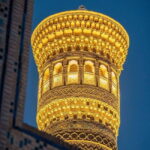
Next you’ll hit the Great Minaret of the Kalon, also known as the Kalyan Minaret. It’s the minaret of the Po-i-Kalyan mosque complex and one of Bukhara’s most prominent landmarks.
Even if you’re not into architecture details, this stop teaches you how Bukhara “speaks” to you from a distance. Once you see the minaret’s scale and placement, the rest of the old town starts to feel legible.
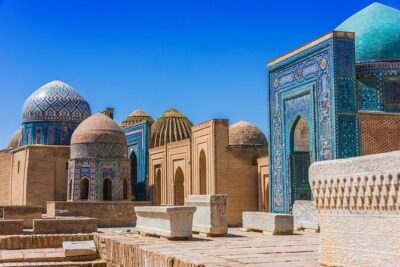
Then the route moves into the Poi Kalyan Mosque complex—Po-i-Kalan is made up of multiple parts, including the Kalan Mosque, the Kalan Minaret, and the Mir-i-Arab Madrasah. That matters because it stops you from viewing each building like a standalone object. Here, they’re a system.
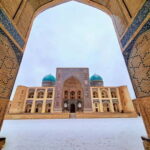
You also visit Mir-i-Arab Madrasa, a school with an especially specific story. It’s described as the only spiritual educational establishment in the USSR that had begun to function after WWII, and the leading imams of that era had graduated from this religious center. That kind of historical detail helps you understand why the place carries weight beyond its tiles and arches.
One consideration: some stops in this complex area don’t list included admission, so plan for extra costs if you want to enter everything.
Bolo Hauz Mosque and the Ark Fortress: where power lived
From the spiritual education side, the tour pivots toward the seat of authority with Bolo Hauz Mosque and the Ark of Bukhara.
Bolo Haouz Mosque was built in 1712 and sits on the opposite side of the Ark in the Registan district. It’s part of the UNESCO World Heritage Site listing, and the date alone gives you a sense of how long this area remained central.
Then comes Ark of Bukhara, a massive fortress initially built and occupied around the 5th century AD. If you want a “wow, this city was serious” moment, this is the stop. Fortresses aren’t just dramatic; they’re practical reminders of how cities defended leadership and managed daily life.
Because your time here is limited (about a half hour), I’d use that time for two things: walk the immediate area in a way that shows the scale, and ask your guide to explain how the Ark connects to the surrounding city layout.
Blacksmith Workshop and Trading Domes: craft and commerce on the same street
One of the smartest surprises in this route is the Blacksmith Workshop stop. It’s focused on reviving and supporting traditional Bukharan handicrafts. You’ll see swords, knives, arrowheads, and craftsmen’s instruments.
Even if you’re not buying anything, I like this kind of stop because it stops the tour from becoming only “look at buildings.” It reminds you that people lived here making tools, weapons, and everyday items—things that moved along the Silk Road economy.
You also visit the Trading Domes, with four domes remaining in the ancient city. They’re positioned along a north-to-south route through the old city. This is one of the spots where the geography matters. The domes help you visualize how movement, trade, and shelter worked together in the past.
Another bonus: some of these stops are listed as free admission (like the blacksmith workshop and trading domes), which helps you feel the value of the included tour without your budget being swallowed immediately by fees.
Madrasas, small mosques, and the “education city” feel
Bukhara is famous for madrasas, and this route gives you a clear slice of that identity.
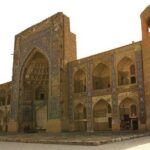
You’ll visit Ulugbek Madrasah, completed in 1420 and noted for exterior tiles, a fluted dome, stained windows, and old tombs. Even if you only catch part of the details, that list of features is a clue: this wasn’t built to be plain. It was built to impress and to teach.
You’ll also go to Abdulaziz-Khan Madrasah. The description you’ll get here links scholarly patronage to Ulughbek and mentions his first madrasa built in 1417 in Bukhara. Since the itinerary is already about education and religious learning, that connection helps you understand patronage as part of the story—not just rulers posing for statues.
There’s also Nodir Devon Begi Madrasasi, built in 1622–1623 by the vizier of Imamkuli-khan. It originally ran as a caravanserai, later converted into a madrasah. I like this stop because it shows how functions changed over time. Buildings didn’t just sit; they adapted as the city’s needs evolved.
Don’t miss Maghak-i ‘Attari Mosque, part of the Lyab-i Hauz religious complex. And include Chor Minor Madrasah, a historic gatehouse for a now-destroyed madrasa, located in a lane northeast of the Lyab-i Hauz complex. A “gatehouse” stop can sound minor on paper, but it often teaches you the urban layout: where entries were placed and how the city framed learning.
Beyond Islam: Bukhara Synagogue on the same route
This tour doesn’t keep everything inside one religious bubble. You’ll also visit the Bukhara Synagogue.
The description notes that before its construction, Jews of Bukhara prayed together with Muslims in the same mosque. That single fact adds emotional context. It’s a reminder that, in the past, communities didn’t always live in separate worlds the way we often assume now.
If you’re trying to understand Bukhara as a real city and not just a monument collection, this is the stop that gives your day a human angle.
Ismail Samani Mausoleum: the calm ending you’ll remember
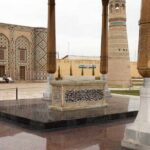
Later, you reach the Ismail Samani Mausoleum, described as a mausoleum in the northwestern part of Bukhara just outside the historic center. It was built in the 10th century CE as the resting place of a powerful and influential figure.
This is a good place to slow down if your morning was intense. Mausoleums can feel more contemplative than public squares or busy complexes, and the “outside the core center” location helps you feel how the historic zone transitions into newer parts of town.
Your guide can help you place it within the larger pattern of the city you’ve been seeing all day.
Price and what you’ll actually budget in total
The tour price is $35.00 per person. That’s for the guided experience, pickup being offered, group discounts, and a mobile ticket.
But you should budget extra for entrances. Entrance fee for museum and historical sites is listed as $6.00 per person, and it’s not included. Tips and gratuities aren’t included either, and lunch isn’t included.
Here’s how I’d judge the value: you’re paying for a structured route through major landmarks—many of which you’d struggle to connect logically on your own. The included professional local guide and the photo opportunities can make that cost feel fair, especially if you’re visiting just once or you want help getting the story right quickly.
If you’re traveling as a small group, the total can feel more noticeable once you add the entrance fee and you still need to handle meals. Plan to keep your day fed, not just sightseeing.
Timing, weather, and stamina: planning your day the smart way
The tour duration is 5 to 8 hours. You should have moderate physical fitness, because this is still a day of moving between sites. Even when each stop is 30 minutes, the walking time and lane navigation add up.
A practical tip: start hydrated and wear shoes you can trust. Bukhara’s old streets can be uneven, and you’ll be standing in courtyards and entrances a lot.
Weather matters here. The experience notes it requires good weather, and if it’s canceled due to poor weather, you’ll be offered a different date or a full refund. That’s especially relevant if you’re traveling in shoulder-season rain or extreme heat.
Also, confirmation is received at booking, and there’s free cancellation available up to 24 hours before the experience start time—handy if your travel plans shift.
Who this tour suits best
This is a great fit if:
- you’re seeing Bukhara for the first time and want a guided route that makes the city easier to remember
- you want both the big-ticket icons (Kalyan Minaret, Poi Kalyan, Ark Fortress) and the smaller context stops (blacksmith workshop, Trading Domes)
- you appreciate learning the story behind religious schools, trade structures, and historic power centers
You might want to skip it if:
- you prefer slow, long stays where you can linger for an hour or two in one building (this route is timed per stop)
- you want lunch included in the price (it isn’t)
Should you book Legends of Bukhara?
If you’re the type of traveler who wants your day to feel organized and your questions answered as you go, I’d book it. The big wins are the way the route connects monuments into a single city picture, and the guide-focused approach that keeps the story understandable—not just a checklist of stops.
Just go in with two expectations: plan time for entrances and don’t treat it like a short stroll. Once you budget the extra $6 per person for historical sites, and you bring your own lunch plans, this becomes a strong value for a full-day introduction to Bukhara.
FAQ
How long is the Legends of Bukhara exclusive full-day tour?
It lasts about 5 to 8 hours.
What is the tour price per person?
The price is $35.00 per person.
Is pickup included?
Pickup is offered.
Is this tour private?
It can be private depending on the option you select, and only your group participates.
Do I need to pay entrance fees?
Yes. Entrance fees for museum and historical sites are listed as $6.00 per person and are not included.
Is lunch included?
No, lunch is not included.
Are there times when admission is free?
Some stops are listed as free admission tickets, including Lyab-i-Hauz, Blacksmith Workshop, Trading Domes, and the Monument to Hodja Nasreddin.
What kind of physical fitness is needed?
The tour calls for moderate physical fitness.
What if the weather is bad?
The experience requires good weather. If it’s canceled due to poor weather, you’ll be offered a different date or a full refund.
What do I get when I book?
You receive a mobile ticket, and the tour includes a professional local guide and photography opportunities.