REVIEW · BUKHARA
Bukhara Full Day Old City Private Tour
Book on Viator →Operated by Malika ST Tours · Bookable on Viator
Old Bukhara feels like a time machine.
This private, guided walking tour is a great way to see the highlights of this UNESCO site without getting stuck decoding it all on your own. Two things I especially like: entrance tickets are included for every paid stop, and the best guides turn the buildings into stories you can actually picture and remember.
The other reason it works is pace. You’ll move through the Kalyan complex, Lyab-i-Hauz, the Ark, and the trading domes in a smooth circuit, with enough time at each place to ask questions. One drawback to plan for: there’s no built-in lunch, so if you want food, you’ll need to ask your guide and build it into your day.
In This Review
- Key highlights to know before you go
- Old Bukhara in a single guided circuit
- Tickets included: the value math actually works
- The guides make the day: stories plus flexibility
- Stop by stop: what you’ll see and how to enjoy it
- Stop 1: Great Minaret of the Kalon (Po-i-Kalyan complex)
- Stop 2: Mir-i-Arab Madrasa
- Stop 3: Chor Minor Madrasah (historic gatehouse)
- Stop 4: Ark of Bukhara (the power center)
- Stop 5: Poi Kalyan Mosque (Kalan Mosque complex)
- Stop 6: Lyab-i-Hauz ensemble
- Stop 7: Bolo Hauz Mosque (1712, UNESCO-listed)
- Stop 8: Nodir Devon Begi Madrasasi (mosaic gate plus activity)
- Stop 9: Monument to Hodja Nasreddin
- Stop 10: Trading Domes (four remaining)
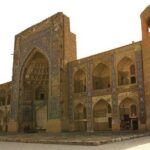
- Stop 11: Abdulaziz-Khan Madrasah
- Stop 12: Ulugbek Madrasah (1420)
- Stop 13: Maghak-i ’Attari Mosque (Lyab-i Hauz complex)
- Stop 14: Bukhara Synagogue (free)
- How long it takes and how to plan your day
- What to do with photos and museum charges
- Who this tour is best for
- Should you book the Bukhara Full Day Old City Private Tour?
- FAQ
- What is the duration of the Bukhara Full Day Old City Private Tour?
- How much does the tour cost?
- Is this tour private?
- Are entrance tickets included?
- Are photo or video fees included?
- Is pickup included?
- Is lunch included?
- What’s the cancellation policy?
- What should I wear or prepare for since it’s a walking tour?
Key highlights to know before you go
- Tickets handled for most monuments: You pay less up front and spend more time looking.
- A real local guide experience: Guides like Sunny, Maksad, Bekhruz, and Shakhnoza are praised for turning stone and tile into clear, human stories.
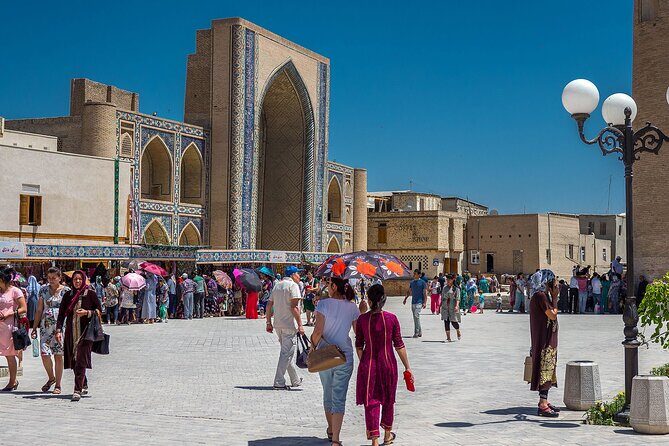
- Top sights are clustered: Kalon, Lyab-i-Hauz, and the trading domes are close enough to do in one day.
- On-foot Old City circuit: Comfortable shoes matter, because it’s a walking day.
- Photo/video charges may pop up: Some museums ask for about $1 per site if you want to shoot.
Old Bukhara in a single guided circuit
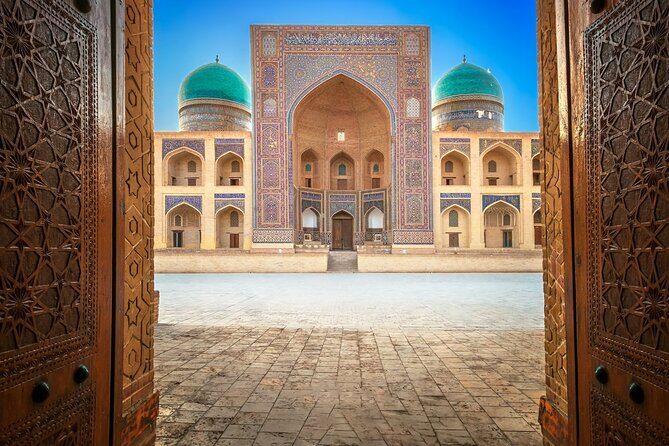
Old Bukhara is the kind of place where it’s easy to see beautiful buildings and still miss what they meant. This tour’s structure helps you avoid that. You’re guided through the landmarks that shaped the city’s religious life (mosques and madrasas), its power (the Ark), and its economy (the trading domes), so the day adds up to something.
Because it’s private, you’re not stuck watching other people’s pace or interests. And because you start and end at the same meeting point near Hotel Malika-Bukhara on Gavkushon Road 25, you don’t spend your day playing navigation games.
You can also read our reviews of more city tours in Bukhara
Tickets included: the value math actually works
At $85 per person for a private day, the best value is that most entries are already covered. The tour includes admission tickets to the paid monuments like the Great Minaret of the Kalon, Mir-i-Arab Madrasa, the Ark, Lyab-i-Hauz sites, Nodir Devon Begi Madrasasi, and the Ulugbek-linked madrasas, plus the synagogue entry.
What’s not included is also worth knowing: there can be a photo/video charge (about $1 per site) paid directly to museums, and tips are not included. If you’re the type who takes lots of pictures inside museums or ticketed spaces, keep some small cash handy so you’re not stuck at the door.
The guides make the day: stories plus flexibility
A walking tour can be either a checklist or a real experience. The stand-out theme here is how much guides focus on context and conversation. In particular, guides such as Maksad, Sunny, Bekhruz, and Malika have been described as prompt, patient, and strong at explaining what you’re looking at.
Another practical win: several guides are described as flexible with breaks. The timing can vary by day, heat, and how long people linger at certain mosaics or courtyards. One note to keep you prepared: you may need to request a coffee break or lunch stop, since lunch isn’t built into the schedule.
Stop by stop: what you’ll see and how to enjoy it
Stop 1: Great Minaret of the Kalon (Po-i-Kalyan complex)
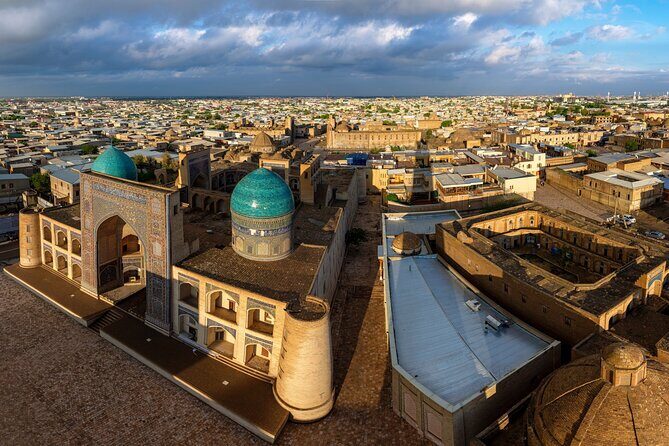
You start with the Kalyan Minaret, one of Bukhara’s most recognizable landmarks. This is the city’s vertical anchor—thin lines, towering height, and the kind of architecture that makes the rest of the Old City feel even more intentional.
Since the entry ticket is included here, you can focus on looking instead of worrying about paperwork. Spend a little time from different angles and try to spot how the complex’s parts relate to each other.
Consideration: If you’re expecting a long, museum-style interior, this stop is more about the structure and the immediate surrounding complex. For that reason, arrive ready to look up.
You can also read our reviews of more private tours in Bukhara

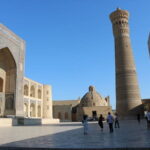

Stop 2: Mir-i-Arab Madrasa
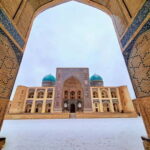
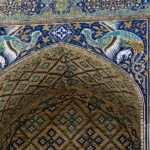
Next is the Mir-i-Arab Madrasa, famous for its detailed tile work and a large hall area around a courtyard that connects to a mosque. This is where you start seeing the pattern that repeats across Bukhara: design that’s meant to teach, impress, and guide daily life.
You’ll get time here to slow down and really notice the surface details—those patterns are the closest thing Bukhara has to a visual language.
Tip: Ask your guide to explain what the madrasa is meant to do beyond being beautiful. In a good tour, the building starts behaving like a character in the story.
Stop 3: Chor Minor Madrasah (historic gatehouse)
The tour then moves to Chor Minor, also called the Madrasah of Khalif Niyaz-kul. What’s special here is that it’s a historic gatehouse connected to a madrasa that’s no longer standing in full form.
This stop works well if you like places that show what history did to architecture over time. You can see how Bukhara’s story includes change, loss, and rebuilding, not just preservation.
Stop 4: Ark of Bukhara (the power center)
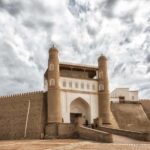
The biggest “weight” of the day comes at the Ark of Bukhara, a fortress-citadel first built and occupied around the 5th century AD. You’ll spend about 1 hour here, which is important because the Ark is not a quick photo stop. It’s where you sense that Bukhara’s religious life wasn’t separate from politics.
If you want your guide to do their best work, this is the moment. A strong guide explains why these fortresses mattered and how the city’s rulers fit into the bigger Silk Road world.
Consideration: Because it’s a fortress area, you’ll likely be walking and climbing more than at some of the courtyard-based stops. Wear shoes you trust.
Stop 5: Poi Kalyan Mosque (Kalan Mosque complex)
Right after the Ark, you return to the Po-i-Kalan / Poi Kalyan religious complex area. This complex is made of three connected parts: the Kalan Mosque, the Kalan Minaret, and the Mir-i-Arab Madrasah.
It’s a smart design for a tour day, because it lets you understand how the pieces belong together. You’re not just seeing one building—you’re seeing a whole system.
Tip: If your brain feels full, ask one simple question: How does this complex function as a whole? You’ll walk away with a cleaner mental map.
Stop 6: Lyab-i-Hauz ensemble
Now you hit Lyab-i-Hauz, with multiple monumental buildings around it, including Kukeldash Madrasah, a khanaka, and Nodir Divan-begi. This is the part of Old Bukhara that feels lived-in. It’s where you can watch the architecture meet everyday life.
The time here is about 30 minutes, which is perfect for a short reset: sit for a moment, take in the layout, and let your guide connect the dots between education, worship, and community.
Stop 7: Bolo Hauz Mosque (1712, UNESCO-listed)
The Bolo Haouz Mosque is next, built in 1712, and located across from the citadel of the Ark in the Registan district. That positioning is one of the reasons it matters: it helps you feel the relationship between the city’s power site and its religious space.
Time is shorter here (about 15 minutes), so treat it as a stop for focus rather than roaming.
Stop 8: Nodir Devon Begi Madrasasi (mosaic gate plus activity)
This stop brings you to the Nodir Devon Begi Madrasasi, described as lively, with an ornate mosaic-covered gate and a courtyard where there are shops and folk dance shows.
This is a useful break from pure history because it gives you some of the sensory side of Bukhara—the sights, sounds, and the sense that culture isn’t just preserved, it continues.
Stop 9: Monument to Hodja Nasreddin
Then you get a different kind of storytelling: a bronze statue of Hodja Nasreddin beside the Lyab-i-Hauz complex. The monument was installed in 1979 and brings a humorous, human side to the square.
Time is about 15 minutes, so don’t rush it. If you like local characters and folktales, this is the kind of detail that makes a tour feel personal.
Stop 10: Trading Domes (four remaining)
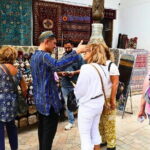
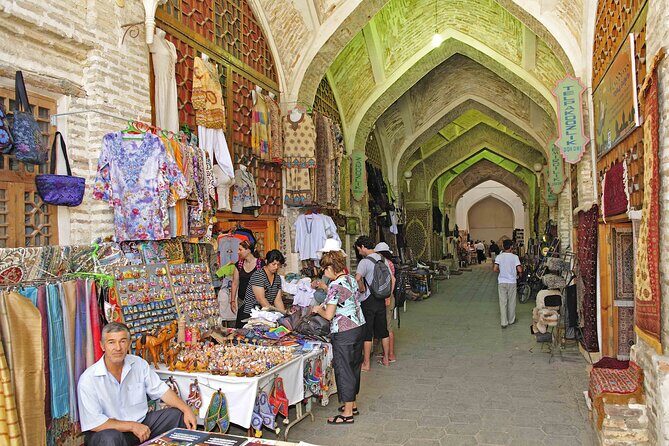
The day’s shopping-energy moment is the Trading Domes. You’ll see four trading domes that remain in the old city, arranged along a north-to-south route. Time is listed as about 1 hour, and that’s for a reason: you’re meant to actually experience the old trade layout.
Even if you don’t buy anything, you’ll learn how the city handled commerce—where goods moved, how streets fed into the domes, and why this area kept pulling people in.
Consideration: If you want shopping time, this is the place. If you prefer pure sightseeing, still walk it slowly once, then move on.
Stop 11: Abdulaziz-Khan Madrasah
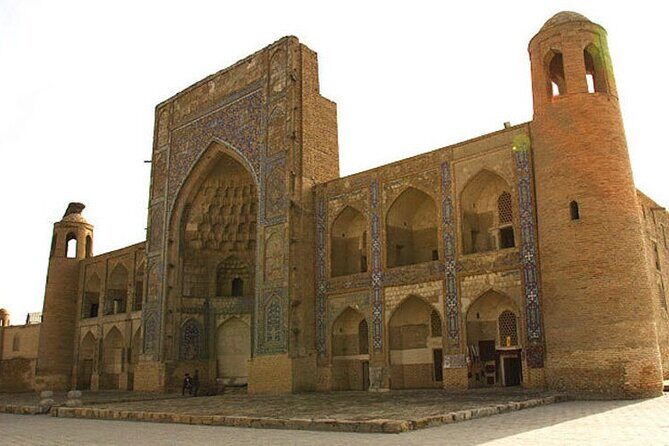
Next is Abdulaziz-Khan Madrasah. The note here links it to Ulughbek’s scholarly work—specifically his first madrasa in 1417 in Bukhara. A good guide will help you connect the architecture to the idea of patronage: rulers supporting learning and scholarship through built form.
Time is about 20 minutes, so plan to focus on key exterior design and what your guide highlights.
Stop 12: Ulugbek Madrasah (1420)
The Ulugbek Madrasah follows, completed in 1420, with exterior tiles, a fluted dome, stained windows, and old tombs. This is one of the most visually “dense” stops because it’s all about surfaces and details.
Tip: Ask your guide where to look first. A small pointing moment can save you from missing the best details while trying to photograph everything.
Stop 13: Maghak-i ’Attari Mosque (Lyab-i Hauz complex)
Then comes the Maghoki Attori Mosque, described as part of the historical religious complex of Lyab-i Hauz. This is a smaller stop but valuable, because it reinforces the idea that one central area can hold multiple layers of worship and community functions.
Time is about 20 minutes, so it’s great for a calm, focused pause after the more detail-heavy madrasas.
Stop 14: Bukhara Synagogue (free)
Finally, you visit the Bukhara Synagogue, with the tour framing it in terms of the historic role of Bukhara Jews in Central Asian and Silk Road civilization. The entry here is listed as free, and time is about 30 minutes.
This ending matters because it widens the story beyond the Islamic monuments. A careful guide helps you see Bukhara as a crossroads city, not a single-story city.
How long it takes and how to plan your day
The duration is typically 5 to 7 hours, and the stops are spaced to allow time inside and short exterior transitions. Because it’s on foot, your schedule needs comfortable shoes and some patience with walking.
A useful planning mindset is this: plan for a mid-day rhythm. Even when the tour is “tight,” you’re still likely to want breaks to rest your feet and recharge your brain. And since lunch is not guaranteed in the schedule, ask your guide early if you’d like a plov or a coffee stop during the day.
What to do with photos and museum charges
Many people get surprised at the end of a beautiful day when they realize photo/video rules differ by site. Here, the tour data is clear: photo/video charges are paid directly to museums at about $1 per site.
So if you’re a heavy shooter, budget for that. If you’re more casual, you can often treat it as a small add-on and still enjoy the day without stressing.
Who this tour is best for
This tour shines if you’re:
- In Bukhara for the first time and want a solid orientation
- More interested in meaning and context than just pictures
- Happy to walk and want a guided circuit rather than a driver-and-stop routine
- The type who asks questions and likes a guide who can explain legends alongside architecture
It’s also a strong fit for people who want a smoother day. Several guides have been described as punctual and flexible, so if you need a pause or want a bit of shopping time, you’ll usually have room to work it in.
Should you book the Bukhara Full Day Old City Private Tour?
Yes, if you want your Old City visit to feel organized and explained. The biggest selling point is that you get a true highlights loop with entrance tickets included and a guide who can connect the dots between buildings, culture, and everyday life.
I’d think twice only if you hate walking or you expect lunch and long museum-style time without asking. Since lunch isn’t part of the included plan, you’ll need to manage that yourself. Also, because photo/video charges can come up, plan a little extra for shooting inside.
If your goal is to leave Bukhara with a clear mental map and stories you’ll repeat later, this private tour is a solid way to do it.
FAQ
What is the duration of the Bukhara Full Day Old City Private Tour?
It usually runs about 5 to 7 hours.
How much does the tour cost?
The price is $85.00 per person.
Is this tour private?
Yes. It’s listed as a private tour/activity, so only your group participates.
Are entrance tickets included?
Yes. The tour includes admission tickets to all listed monuments.
Are photo or video fees included?
No. Photo/video charges may apply and are paid directly to museums at about $1 per site.
Is pickup included?
Pickup is offered, and the meeting point is Hotel Malika-Bukhara on Gavkushon Road 25. The tour ends back at the meeting point.
Is lunch included?
Lunch is not included in the tour details provided, so you may need to ask your guide if you want time to eat.
What’s the cancellation policy?
Free cancellation is allowed up to 24 hours in advance for a full refund.
What should I wear or prepare for since it’s a walking tour?
The tour is on foot, so plan for comfortable walking shoes and a day that includes moving between many sites.