REVIEW · BUKHARA
Bukhara Historical City Highlights Guided Walking Tour
Book on Viator →Operated by Tourmania · Bookable on Viator
Bukhara’s monuments come at you fast. This 4-hour guided walking tour is a smart way to see the big-name landmarks close together, with clear explanations in English that make the city’s Islamic-era architecture easier to remember. I also like the pace: it’s full coverage without turning into an all-day slog.
The only real catch is money on the ground. Some of the stops include free viewing, but others don’t, so you should expect to pay for admission on certain sights during the route.
In This Review
- Key highlights you’ll notice right away
- Why This Bukhara Historical City Highlights Walk Works
- Starting at Khodja Nasreddin Statue: A fast way to get oriented
- Stop-by-stop: Nodir Devon Begi, Lyab-i-Hauz, and Toki Sarrofon
- Nodir Devon Begi Madrasasi: complex history in one sight
- Lyab-i-Hauz: the pool-centered heart of Bukhara
- Toki Sarrofon: trade domes that explain everyday commerce
- Mosques and the skyline: Magoki Attori, Kalan Minaret, Poi Kalyan
- Magoki Attori Mosque and Carpet Museum: a blend of faith and craft
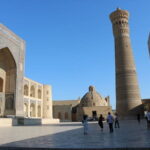
- Kalan Minaret: the skyline landmark you’ll remember
- Poi Kalyan Mosque: size and significance in one final stop
- Price and value: what $24 covers—and what it doesn’t
- The guide experience: licensed, small group, and built for questions
- How to make the most of a 4-hour old-city walk
- Should you book this Bukhara walking tour?
- FAQ
- What is the duration of the Bukhara Historical City Highlights guided walking tour?
- How much does the tour cost?
- What’s included in the price?
- Are admission tickets included?
- Where do you start and end the tour?
- How large is the group?
Key highlights you’ll notice right away
- Professional licensed guide who can translate the why behind the landmarks, not just the what
- Tight route for a short stay: major sights in about 4 hours
- Mix of free and paid stops so you can budget better than you might expect
- Central old-city focus around the classic Bukhara monuments and their shared atmosphere
- Small group size (max 15) for questions, photos, and breathing room
Why This Bukhara Historical City Highlights Walk Works
If you only have a limited amount of time in Bukhara, you’ll appreciate how this tour is built around proximity. Instead of bouncing around the city, you’re guided through a cluster of historic points that help you understand how the old city is organized—religious sites, trading spaces, and major public areas all sitting close enough to connect in your mind.
I also like that you get structure. A guided plan turns wandering into recognition. When you’re standing in front of something like the Kalan Minaret or the Poi Kalyan Mosque, it helps to have a guide pointing out what matters, rather than guessing based on exterior beauty alone.
You can also read our reviews of more walking tours in Bukhara
Starting at Khodja Nasreddin Statue: A fast way to get oriented
You begin at the Khodja Nasreddin statue (listed at QCFC+5FM, Bukhara). That’s a good anchor point because it gives you a clear start before you step into the older lanes of the city center.
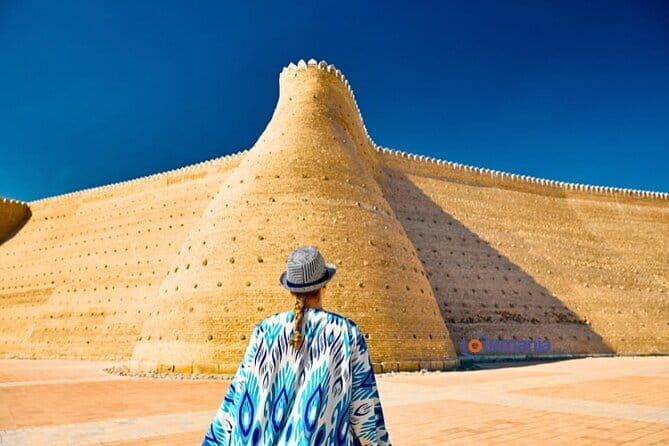
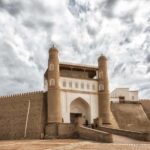
From there, you’ll walk stop to stop. The tour ends at the Ark of Bukhara area (Afrosiab St, listed at QCH5+6W6). That ending matters: the Ark zone is a handy place to continue on your own after the tour, whether you want more photos, a snack, or to start another loop.
One practical thing: the exact meeting details are shared the day before, so I’d treat your start as a rendezvous with a plan—not a surprise adventure.
Stop-by-stop: Nodir Devon Begi, Lyab-i-Hauz, and Toki Sarrofon
This is where the tour does something smart: it moves through different “types” of landmarks, so Bukhara feels like a living city, not a museum hallway.
Nodir Devon Begi Madrasasi: complex history in one sight
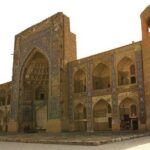
The route begins with Nodir Devon Begi Madrasasi. You’ll spend about 20 minutes here, and the admission for this stop is listed as free.
What I’d focus on is the idea that this madrasah is not just a single building. It’s described as part of a larger complex that includes a caravanserai (an inn for travelers) and a bath (the description is cut off, but it clearly indicates additional facilities). That means your time here is less about one façade and more about understanding how people moved, learned, rested, and refreshed in the same area. Even a short stop can give you a bigger picture if your guide is explaining the connection.
Lyab-i-Hauz: the pool-centered heart of Bukhara
Next is Lyab-i-Hauz (Labi-Hauz) for about 30 minutes. Admission here is listed as not included.
The name matters. The description notes that Labi-Hauz translates as around the pool, and that the complex is centered on a large rectangular pool (the text is truncated, but it clearly points to that centerpiece). This is the kind of stop where you benefit from taking a step back and looking at the layout. A pool-centered public area tells you how daily life worked—social space, rest space, and a focal point for the surrounding architecture.
If you like to understand city design, this stop is a good one. If you only care about individual monuments, you might feel it as a softer stop—still worth it because it helps connect the rest.
You can also read our reviews of more guided tours in Bukhara
Toki Sarrofon: trade domes that explain everyday commerce
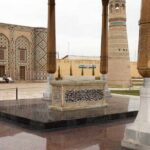
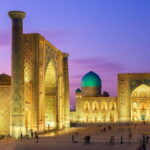
Then you move to Toki Sarrofon, spending about 40 minutes. This stop is listed as free for admission.
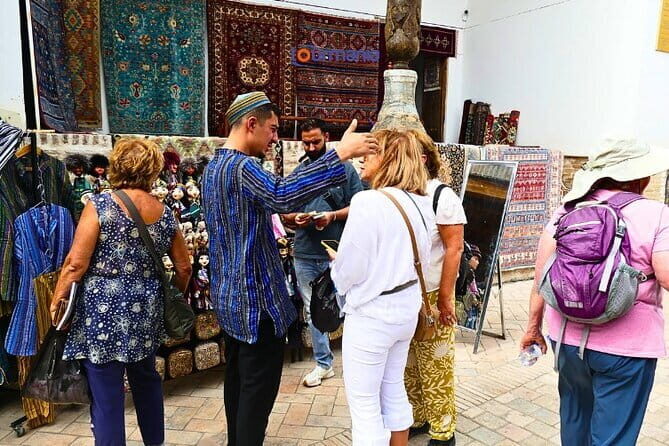
Toki is a key word here: these are trading domes, and the description calls out that Toki Sarrafon was an important center for commerce and trade. So while you’re looking at an architectural structure, your guide should help you see it as infrastructure for the market life of Bukhara—not just decoration.
This is the stop that often clicks for people who like “how things worked.” In a few minutes, you can shift from wow this is old to how this supported trade.
Mosques and the skyline: Magoki Attori, Kalan Minaret, Poi Kalyan
The last third of the tour turns toward the sacred and the iconic. You’ll see three major religious landmarks plus the minaret that ties the skyline together.
Magoki Attori Mosque and Carpet Museum: a blend of faith and craft
You’ll spend around 20 minutes at Magoki-Attori Mosque and Carpet Museum. Admission here is listed as not included.
This stop is listed as one of Bukhara’s most important historical and architectural landmarks, and the mosque is described as a significant example of Islamic architecture in Central Asia. The listing also says it’s renowned for something in its architecture, though the details are cut off in the text you provided—so I’d be ready for your guide to highlight what makes it special in person.
The “Carpet Museum” part is useful because it expands the story beyond buildings. If you’re the kind of visitor who wants architecture plus material culture, this pairing helps. You’ll get a break from pure walking while still feeling like you’re moving through the city’s identity.
Kalan Minaret: the skyline landmark you’ll remember
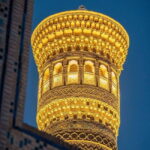
Next comes the Kalan Minaret (about 30 minutes). Admission is listed as not included.
Even without going deep on trivia, this is one of those sights where context helps. The description notes it’s an iconic landmark and a symbol of Bukhara’s rich history and architectural heritage. If you’re taking photos, this is the one to do from multiple angles. If you’re listening, ask your guide what it symbolizes in the city’s story—because the minaret is often easier to appreciate once someone frames it.
Poi Kalyan Mosque: size and significance in one final stop
The tour finishes with Poi Kalyan Mosque for about 30 minutes (also not included for admission).
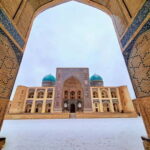
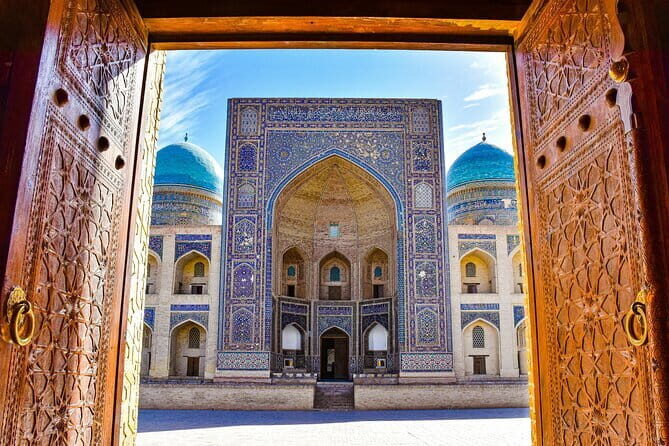
The description calls it one of Bukhara’s most significant and largest mosques, and a key architectural heritage site. This is your chance to take in the scale and the overall composition. For me, the value of ending here is that the city’s architecture feels complete: minaret skyline, mosque centerpiece, then you transition out toward the Ark area.
Price and value: what $24 covers—and what it doesn’t
The tour costs $24.00 per person, lasts about 4 hours, and includes a professional licensed guide plus all taxes. That’s a solid structure for a walking format. You’re paying mainly for expert context and a route that saves you from piecing everything together alone.
What’s not included is admission, which the listing estimates at approximately $20 USD. The good news is that not every stop is paid entry. Nodir Devon Begi Madrasasi and Toki Sarrofon are listed as free admissions, while Lyab-i-Hauz, Magoki-Attori Mosque and Carpet Museum, Kalan Minaret, and Poi Kalyan Mosque are listed as not included. So in practice, you’re not paying for everything—you’re paying for the heavyweight sights where entry is usually required.
If you budget for free + paid mix, the math feels fair rather than surprising.
The guide experience: licensed, small group, and built for questions
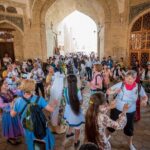
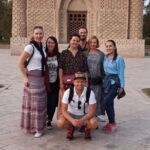
This tour caps at 15 travelers, which I find makes a big difference for walking tours. In a smaller group, you can ask follow-up questions without having the whole line drag behind you.
You’ll also be with a professional licensed guide. The reviews you provided highlight two things that are worth taking seriously: guides with English you can actually follow, and explanations that connect history and culture without drowning you in jargon. One review also specifically calls out a guide named Ruby as attentive and available, and another notes that even when the group is small or you’re solo, the guidance stays sincere and focused.
That’s the real value of a paid guide: you get to spend your attention where it counts.
How to make the most of a 4-hour old-city walk
This tour is designed to feel efficient, but it’s still a walking experience. If you want the best version of it, show up ready for steps.
I’d plan for:
- Comfortable shoes you’ve already tested
- Sun protection if your day is clear (old city paths can feel exposed)
- A camera plan: snap big landmarks, then slow down for details only your guide points out
Also, take advantage of the short time windows. Each stop is only 20 to 40 minutes, so it helps to pick what you want from each: one quick architecture moment, one city-planning moment, one cultural context moment.
Your guide’s job is to connect the dots. Your job is to stay curious.
Should you book this Bukhara walking tour?

I’d book it if you want a structured, time-efficient way to see Bukhara’s key highlights—especially if you’re the kind of traveler who enjoys learning how different spaces (learning sites, public areas, trading domes, mosques) fit together.
Skip it if you’d rather roam independently without admission costs or you’re looking for long museum time at one location. This route is broad and paced for coverage, not for deep, slow study.
If you can spare an afternoon and you like getting your bearings fast, this one is a good bet—four hours that helps you understand what you’re looking at when you wander afterward.
FAQ
What is the duration of the Bukhara Historical City Highlights guided walking tour?
The tour is approximately 4 hours.
How much does the tour cost?
It costs $24.00 per person.
What’s included in the price?
The tour includes a professional licensed guide and all taxes.
Are admission tickets included?
No. Admission tickets are listed as not included (approximately $20 USD), though a couple of stops are listed as free.
Where do you start and end the tour?
You start at the Khodja Nasreddin statue and the tour ends at the Ark of Bukhara area. The exact details are provided the day before.
How large is the group?
The tour has a maximum of 15 travelers.